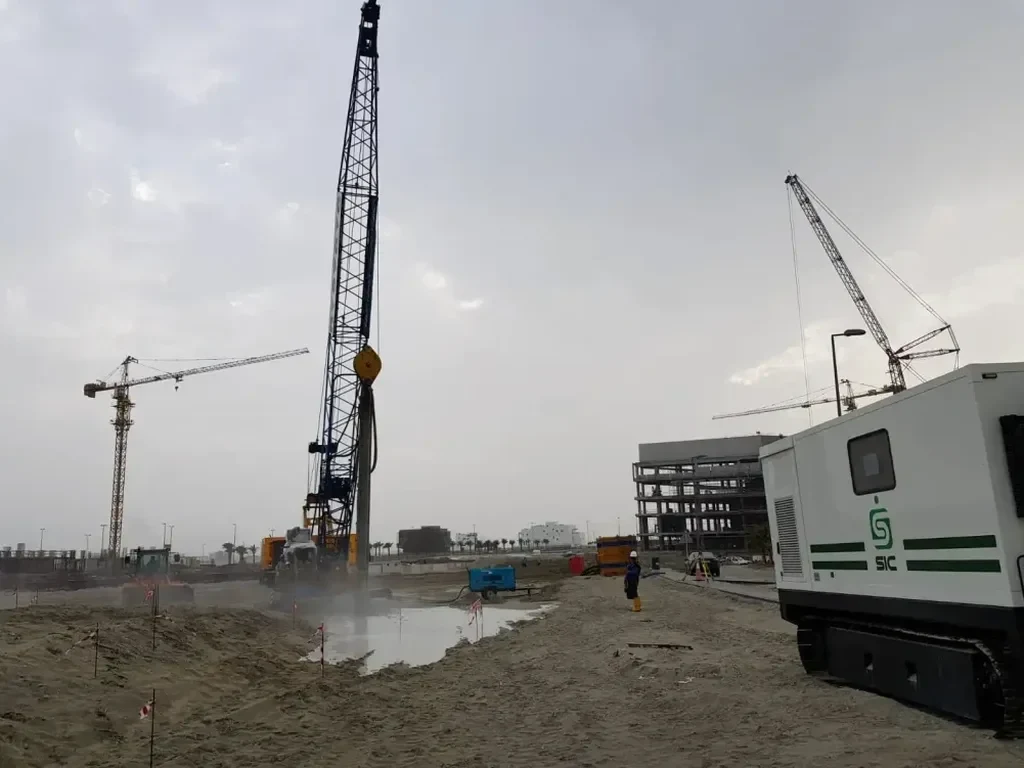
The River Nore carves a low, flood-prone basin through Kilkenny, leaving behind a legacy of soft alluvial deposits that can complicate any construction project. Beneath the medieval streets and new housing estates alike, loose silts and sands demand a ground improvement strategy that goes beyond standard compacted fill. When we design a vibrocompaction campaign for a Kilkenny site, the first step is always understanding how the valley's fluvial history influences relative density at depth. The local water table sits high, often just a couple of metres down, which means achieving consistent densification requires careful energy calibration. We routinely correlate design parameters with in-situ permeability data to confirm that pore pressure dissipation will keep pace with the vibrator's advance. For larger schemes near the ring road, we may also recommend a preliminary MASW survey to map shear wave velocity contrasts before mobilising the rig, ensuring the grid spacing targets the weakest zones from day one.
In the Nore floodplain, vibrocompaction design isn't about maximum depth, it's about matching the vibrator's energy to the grain-size distribution so the ground densifies without liquefying the overlying silt.
Local geotechnical context
IS EN 1997-1:2005 requires that ground improvement designs be validated by an observational method or a rigorous testing programme, and in Kilkenny's layered alluvium this isn't a box-ticking exercise. The most common failure mode we see in under-designed vibrocompaction is differential settlement, where a stiff crust over loose sand masks the problem until structural loads are applied. Another risk specific to the Nore Valley is vibration-induced settlement of adjacent, previously untreated ground. Without a pre-condition survey and real-time monitoring, a rig working too close to a neighbouring property can generate claims faster than it densifies the soil. We insist on pre- and post-treatment CPT pairs at every critical footing location, comparing the cone resistance profiles directly against the design assumptions. The Irish National Annex to the Eurocode also demands that dynamic effects on nearby operations be assessed, a detail that catches out contractors unfamiliar with Kilkenny's maze of Victorian brick sewers beneath the city centre.
Top questions
How much does vibrocompaction design cost for a site in Kilkenny?
The design fee typically ranges from €1,270 to €4,350 depending on the treatment area and the complexity of the ground profile. A small residential plot with straightforward sand lenses sits at the lower end, while a multi-acre commercial site with variable alluvium and proximity to heritage structures requires more detailed analysis and falls toward the upper end.
How do you verify that vibrocompaction actually worked on my Kilkenny site?
We specify a minimum of three pre-treatment and three post-treatment CPT soundings per critical zone, plus occasional PMT tests in the silty layers. The cone resistance profiles must exceed the design threshold across the full treatment depth. If any zone falls short, we re-treat before the rig leaves the site.
Will the vibration damage my neighbour's property in the city centre?
We set peak particle velocity limits in the specification and require continuous vibration monitoring at the nearest sensitive receptor. In Kilkenny's medieval core, we often reduce the vibrator energy near the perimeter and switch to a smaller probe, which takes longer but keeps vibrations well within the safe threshold for historic masonry.
Can vibrocompaction handle the peat pockets we find across parts of Kilkenny?
Vibrocompaction is ineffective in peat because the organic fibres don't densify under vibration. When our ground investigation reveals peat lenses, we either excavate and replace them with engineered fill before treatment, or we switch the specification to a rigid inclusion or piled solution for those specific zones.