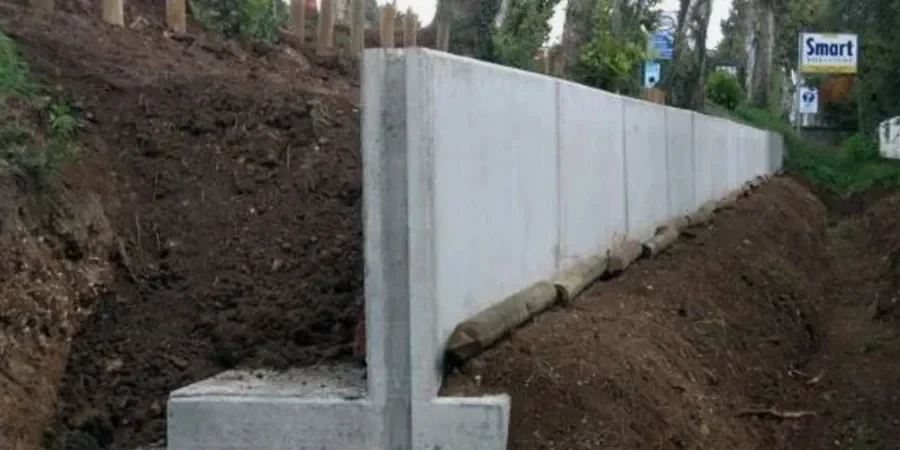
Kilkenny’s topography, shaped by the River Nore cutting through Carboniferous limestone, rarely offers a perfectly flat building site. For projects near the Castle Park escarpment or along the sloping banks west of John’s Bridge, retaining wall design becomes a non-negotiable structural element, not an afterthought. The city’s elevation varies from roughly 40 m to over 100 m in the suburbs, creating differential ground levels that demand precise lateral earth pressure calculations. Our work focuses on delivering Eurocode 7-compliant retaining wall design that accounts for the stiff glacial till and occasional alluvial pockets found across the county. Before finalizing wall geometry, we often correlate subsurface data with in-situ testing; a CPT test helps us map the transition between the boulder clay and the underlying weathered rock, ensuring the design assumptions match what the ground actually reveals during excavation.
In Kilkenny’s glacial till, effective drainage behind the wall reduces lateral thrust by up to 40%, making it a primary design parameter, not a secondary detail.
Scope of work
The underlying geology of Kilkenny is dominated by Dinantian limestone mantled by glacial deposits, which gives us a reasonably competent bearing stratum but introduces variability in the depth to bedrock. This directly influences retaining wall design, particularly for cantilever structures where rotational stability depends on the passive resistance of the backfill. A standard approach in the city’s medieval core involves assessing the historic fill layers, often containing remnants of old brewery foundations or mill races, which behave unpredictably under load. When the retained height exceeds three meters, we integrate
slope stability analysis to verify that the global failure surface doesn’t bypass the wall toe. For sites where the water table sits high—common east of the city near the floodplain—drainage design becomes as critical as the structural section. We specify granular backfill and weep holes to manage hydrostatic pressure, preventing the build-up of forces that can overwhelm even a well-reinforced concrete stem. In constrained urban plots where excavation space is limited, techniques like
anchors provide the lateral restraint without requiring extensive benching, allowing the wall to remain slender while resisting the thrust from adjacent historic structures.
Local geotechnical context
Kilkenny’s compact urban grain, with its narrow lanes and abutting party walls, leaves zero margin for excavation-induced movement. The city’s expansion from a monastic settlement into a medieval trading hub created a dense core where any new retaining wall design must protect neighboring structures, some dating back to the 13th century. The biggest geotechnical risk here isn’t wall collapse—it’s serviceability failure manifesting as lateral deflection that cracks a shared gable or disrupts a protected façade. Uncontrolled groundwater behind a wall can wash fines from the glacial till, leading to progressive settlement of the pavement behind the coping. Our methodology includes monitoring points and displacement limits agreed with the design team, ensuring that the wall moves within tolerable bounds. In the limestone bedrock, we also check for karst dissolution features, which can create hidden voids behind the wall stem and alter the assumed active wedge geometry.
Top questions
How much does retaining wall design cost for a residential project in Kilkenny?
For a typical residential retaining structure in the city, fees for the geotechnical design and the structural analysis generally fall between €820 and €3,820. The final figure depends on the wall height, the complexity of the ground investigation data, and whether you need detailed construction-stage monitoring.
Which load cases are critical for retaining wall design under Eurocode 7 in Ireland?
We apply the Irish National Annex to EN 1997-1, which directs us to Design Approach 1. This means checking both Combination 1 (factors on structural actions and soil strength) and Combination 2 (factors on geotechnical actions and resistance). We also assess accidental and seismic load cases, though Kilkenny’s low seismicity means wind and surcharge usually govern.
How do you manage groundwater pressure behind a retaining wall in Kilkenny's clay soils?
Even in the boulder clay, perched water can build up after heavy rain. We specify a free-draining granular backfill wedge, a filter geotextile to prevent clogging, and weep holes spaced at 1.5-2.0 m centers. For walls with high retained heights, we design a blanket drain at the base to relieve the phreatic surface before it generates excessive hydrostatic thrust.
Can you design a retaining wall right on the property boundary in the city center?
Yes, but it requires a slim profile, usually an embedded or anchored wall. In the medieval streets, we often propose a contiguous pile wall installed from the existing ground level, which avoids over-excavation. The design accounts for the adjacent building’s surcharge and any historical basements that might reduce the passive zone.