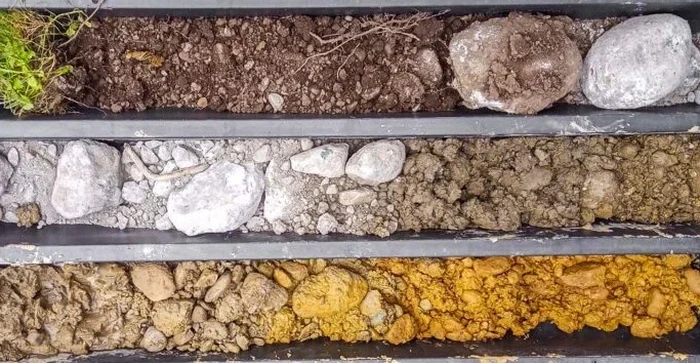
Kilkenny sits on Carboniferous limestone mantled with glacial till of varying thickness. Depth to rock changes abruptly. On the Callan road you hit weathered limestone at 1.2 m; nearer the Nore floodplain, alluvial silts and gravels extend past 4 m. A trial pit logs that transition in hours. The team excavates to 3.5 m standard depth, photographs the faces, measures water ingress and collects bulk disturbed samples. Where boulder clay dominates, the plate load test quantifies bearing capacity at formation level, while the sand cone density checks compaction on backfill lifts. BS 5930:2015 + A1:2020 guides logging procedure; the pit log becomes a permanent record for the designer.
One test pit with a good log replaces three boreholes for shallow foundation decisions.
Top questions
How much does a single exploratory test pit cost in Kilkenny?
A standard single pit to 3.5 m depth, including machine hire, operator, logging engineer, photographic record, water strike monitoring and reinstatement, ranges between €500 and €810. The final figure depends on access, ground conditions and whether sampling or in-situ testing is added.
What is the difference between a test pit and a borehole for shallow foundations?
A test pit exposes a continuous vertical face so the engineer sees layering, fissures and groundwater directly. A borehole gives a discontinuous core. For foundation depths under 3 m, the pit provides better visual data and larger bulk samples, but it cannot go as deep as a cable-percussion or rotary borehole.
How soon can a test pit be excavated and backfilled on a Kilkenny site?
A single pit is normally excavated, logged, sampled and backfilled within four hours, assuming straightforward ground and no buried operations. The log and photographs are issued the same working day. Lab results from collected samples follow in seven working days.