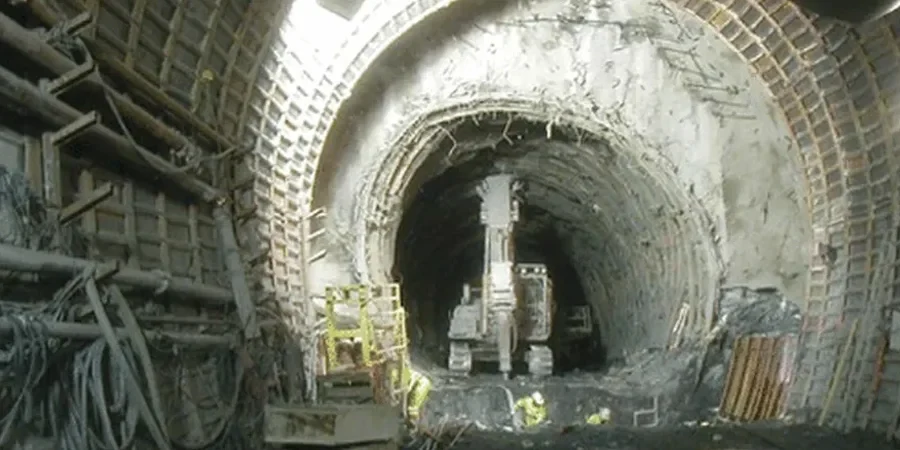
Kilkenny sits at roughly 60 meters above sea level on the banks of the River Nore, but it is what lies beneath the medieval streets that challenges any underground project. The city’s subsurface is a legacy of the last glaciation: layered sequences of soft alluvial silts, peat pockets, and stiff glacial tills that can change within meters. When a tunnel boring machine or a pipe jacking operation encounters these transitions without warning, the cost overruns hit fast. Our geotechnical analysis for soft soil tunnels maps these transitions in advance, giving contractors a reliable ground model rather than a set of surprises. We apply Eurocode 7 (I.S. EN 1997-2:2007) ground investigation principles—combining borehole logging, in-situ testing, and laboratory classification—to define the deformation and strength parameters that govern tunnel face stability in Kilkenny’s mixed soft ground. For projects near the Nore floodplain, integrating a CPT test with rotatory boreholes often clarifies the depth to competent till before a single meter of tunneling is programmed.
In Kilkenny’s mixed glacial deposits, tunnel face stability is governed not by average strength but by the weakest meter of ground—and that meter is rarely where the desk study says it is.
Local geotechnical context
A 2.4-meter diameter sewer tunnel being jacked beneath the Irishtown area hit a lens of saturated peat that had not appeared on the pre-tender site investigation. The face collapsed within 90 seconds of exposure, the ground loss propagated to the surface, and a section of road above settled 180 millimeters before the crew could stabilize the heading. The repair took three weeks and consumed the project’s entire contingency. In Kilkenny’s soft soil environment, this scenario is not an outlier—it is the predictable result of skipping a targeted geotechnical analysis for soft soil tunnels before selecting the excavation method. Our approach eliminates this gamble: we map the distribution of compressible organic layers using closely spaced dynamic probing and targeted undisturbed sampling, define the undrained strength profile that governs face support pressure, and specify the maximum allowable advance rate before pore pressures build to dangerous levels. When the analysis is done before the TBM arrives on site, the tunnel drive becomes a controlled process rather than a reactive one.
Top questions
What is the typical cost range for a geotechnical analysis for soft soil tunnels in Kilkenny?
The investment typically falls between €4,260 and €16,060, depending on the length of the tunnel alignment, the number of investigation points required, and the complexity of the laboratory testing program. A short pipe jack beneath a road crossing requires fewer boreholes and simpler testing than a long sewer tunnel passing beneath multiple structures, which demands a denser investigation grid and advanced triaxial testing.
How do you account for the variable glacial deposits found under Kilkenny?
We design the investigation to capture lateral and vertical variability by using closely spaced CPT soundings between borehole locations. The CPT provides a continuous strength and soil type profile, which we then ground-truth with targeted sampling at depths where the signal indicates a transition. This approach prevents the interpolation errors that occur when relying on boreholes alone in heterogeneous glacial sequences.
Which laboratory tests are most critical for soft ground tunnel design?
Consolidated-undrained triaxial tests with pore pressure measurement give us the effective stress strength parameters needed for face stability calculations. Oedometer tests carry out the stiffness and consolidation coefficients for settlement prediction. Atterberg limits and particle size distribution classify the soil for TBM selection, and organic content tests identify peat layers that behave very differently from mineral soils under load.
How long does a tunnel-specific ground investigation take in Kilkenny?
Fieldwork typically requires one to two weeks for a standard alignment, depending on access constraints in the urban area. Laboratory testing adds three to four weeks for the full suite of triaxial and consolidation tests. The geotechnical interpretative report, including the ground model and design parameters, is delivered within five to six weeks from mobilization. We coordinate with Kilkenny County Council for any road opening permits well in advance to avoid delays.