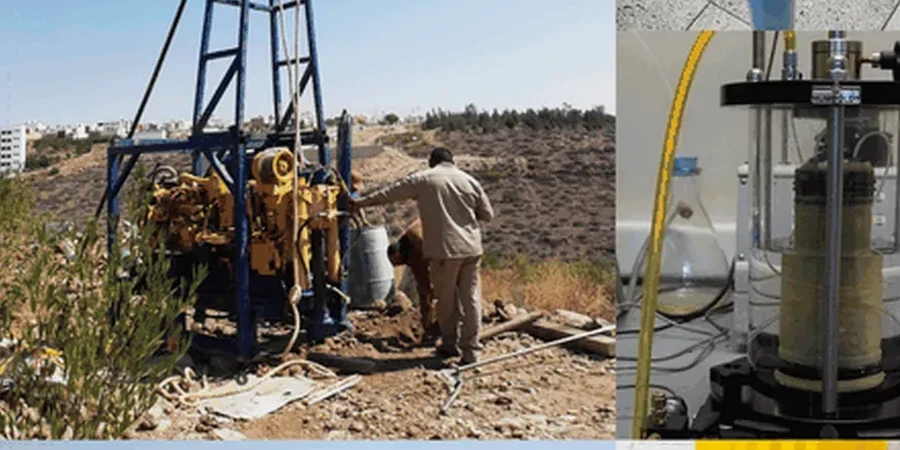
The drill rig arrives on site in Kilkenny with a full complement of Shelby tubes, split-spoon samplers, and core barrels suited to the local geology. We set up on a project near the River Nore, where the alluvial deposits overlying the Waulsortian limestone demand careful recovery techniques. Before the first borehole advances, our team reviews the site history against Ordnance Survey Ireland mapping and GSI Quaternary sediment records. A proper soil mechanics study here is not a generic exercise. The limestone karst features found across County Kilkenny introduce voids and variable rockhead that standard penetration testing alone often misses. We combine rotary coring with laboratory index testing to build a geotechnical model that reflects the true subsurface complexity. This approach has proven essential for developments from the medieval city centre outward to the expanding suburbs, where engineers must reconcile modern Eurocode requirements with a landscape shaped by glacial and fluvial processes over millennia.
Characterising Kilkenny's glacial till and karst limestone properly requires integrating field logging, lab testing, and a deep understanding of local Quaternary geology.
Scope of work
The temperate maritime climate of Kilkenny, with average annual rainfall around 820 mm, creates seasonal groundwater fluctuations that directly influence soil behaviour. Saturation of the glacial till during wet winters reduces effective stress and can lower bearing capacity by 15 to 20 percent compared to summer conditions. Our soil mechanics study accounts for this variability by scheduling in-situ testing during representative moisture periods and by running consolidated-undrained triaxial tests on samples recovered from the critical depth. When the till matrix contains lenses of sand and gravel, we often complement the analysis with an in-situ permeability test to quantify hydraulic conductivity, which is essential for dewatering design. The limestone bedrock, while competent at depth, frequently exhibits pinnacled rockhead profiles where the overburden thickness can vary by several metres across a single building footprint. This erratic interface demands targeted investigation, and we sometimes deploy a
CPT test to provide continuous stratigraphic profiling where access permits, detecting thin soft zones that traditional borehole spacing might overlook. In areas where the till transitions to alluvium near the Nore, the soil mechanics parameters shift markedly, and the
grain size distribution analysis becomes a fundamental input for assessing internal erosion risks in embankment and retaining structure design.
Local geotechnical context
Eurocode 7 (I.S. EN 1997-1:2004 and I.S. EN 1997-2:2007) mandates that geotechnical investigations address geological uncertainty explicitly, and in Kilkenny this requirement carries real weight. The limestone bedrock underlying much of the city and county is Carboniferous in age and has undergone extensive karstification. Cavities, widened joints, and sudden drops in rockhead are documented across the region. Founding a structure on what appears to be competent rock without verifying the absence of voids beneath can lead to catastrophic differential settlement. Even where rock is sound, the overlying glacial till can contain soft pockets and lenses of saturated silt that go undetected by widely spaced boreholes. A soil mechanics study that relies on minimal investigation points leaves the designer exposed to conditions that Eurocode 7 would classify as high geotechnical risk. The National Annex for Ireland (I.S. EN 1997-1 NA:2010) reinforces the need for adequate ground investigation, and in Kilkenny's variable terrain, that means combining boreholes, laboratory testing, and geophysical methods where karst features are suspected. The financial and structural consequences of overlooking a dissolution feature or an artesian groundwater condition can be severe.
Top questions
What does a soil mechanics study in Kilkenny typically cost?
The cost for a soil mechanics study in Kilkenny generally falls between €2,590 and €5,040, depending on the number of boreholes, the depth to rock, and the laboratory testing suite required. A project on a straightforward till site with two boreholes and basic index testing will sit at the lower end, while a site with karst features, deep rock coring, and triaxial testing will move toward the upper end of that range.
How deep do you drill for a soil mechanics study in Kilkenny?
Borehole depth is determined by the foundation type and the geological conditions encountered. In Kilkenny, where limestone rockhead typically lies between 2 and 10 metres below ground level in the city centre and suburbs, we generally extend boreholes a minimum of 3 metres into competent rock or to a depth where the applied stress from the foundation becomes negligible. For deeper piled foundations or where karst features are suspected, depths may exceed 15 to 20 metres.
Which standards govern a soil mechanics study in Ireland?
The principal standards are I.S. EN 1997-1:2004 (Eurocode 7, Part 1) with its Irish National Annex, and I.S. EN 1997-2:2007 (Eurocode 7, Part 2) covering ground investigation and testing. We also follow BS 5930:2015 for investigation procedures and SR 21:2014 for guidance on applying Eurocode 7 in Ireland. All laboratory testing is performed under ISO 17025 accreditation through INAB.
What are the main soil types you encounter in Kilkenny?
The dominant soils across Kilkenny are glacial tills deposited during the Pleistocene, typically described as firm to stiff sandy silty clays with varying gravel content. These overlie Carboniferous limestone of the Waulsortian and Ballysteen formations. Along the River Nore corridor, we encounter alluvial silts and sands, and in isolated pockets, soft organic clays. The till is generally overconsolidated due to ice loading, which gives it relatively favourable engineering properties, though its heterogeneity requires careful characterisation.