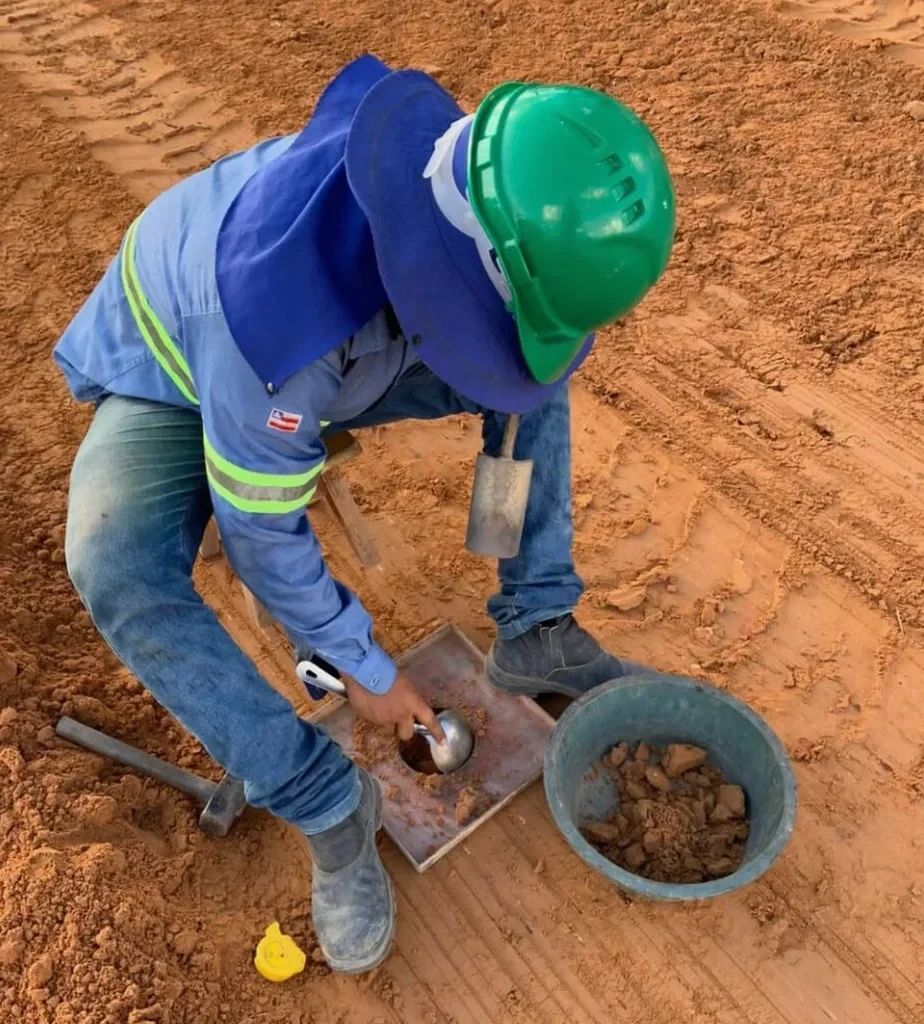
A calibrated sand cone apparatus arrives on site in Kilkenny: a one-gallon plastic jar filled with uniform, dry Ottawa sand, a precision-machined base plate with a six-inch opening, and a sensitive field scale reading to the nearest gram. The technician sets the plate on the compacted surface of a limestone fill — typical of roadworks along the N77 corridor — and carefully excavates a test pit whose volume will later be measured by the weight of sand required to fill it. This is the sand cone method, performed to BS 1377-9:1990 and the relevant Irish guidance in the NRA Manual of Contract Documents for Road Works. In a city where glacial till and Carboniferous shales create variable subgrades, getting density right before asphalt goes down saves thousands in premature deformation. The sand cone density procedure remains the contractor’s go-to reference test because it is direct, affordable, and understood by every site agent in the southeast.
A single sand cone test on a poorly compacted lift can save an entire road reconstruction later — the cost of re-rolling is measured in hours, not months.
Local geotechnical context
The recurring mistake in Kilkenny is accepting compaction records based solely on roller pass counts without a single density verification. A contractor will log eight passes of a Bomag BW 211, tick the sheet, and move on, only for the next rainstorm to reveal settlement of 40 mm under the wheel tracks because the underlying limestone gravel had degraded into fines during compaction and trapped water instead of draining it. By the time the pavement is placed, the deformation is locked into the subbase and the only remedy is a full-depth excavation. A well-documented sand cone campaign, with tests taken immediately behind the roller and referenced to the material’s Proctor curve, prevents this sequence completely. It also protects the designer’s assumptions — because a 95 % relative compaction target that is never measured is just a wish, not an engineering specification.
Relevant standards
BS 1377-9:1990 — Methods of test for soils for civil engineering purposes, Part 9: In-situ density tests, NRA Manual of Contract Documents for Road Works, Series 600 — Earthworks, including Clause 612 and 613 for compaction control, I.S. EN 13286-2:2010 — Unbound and hydraulically bound mixtures — Test methods for laboratory dry density and water content, TII Publication CC-SPW-00600 — Specification for Road Works: Earthworks (Ireland)
Top questions
How much does a field density test using the sand cone method cost in Kilkenny?
A single sand cone density test in the Kilkenny area typically runs between €110 and €130 per point, depending on the number of tests ordered in a single visit and the travel distance from the laboratory. For a full day of compaction trial support with multiple tests, we carry out a day rate that reduces the per-test cost significantly.
How quickly do you get results from a sand cone density test?
The dry density and relative compaction are calculated on site within about 15 minutes of taking the sample. The technician weighs the excavated material, measures the sand volume, and computes the result directly on the field worksheet. If the laboratory Proctor reference is already available, the percentage compaction is available immediately.
What is the minimum number of tests required per day on an earthworks site?
The NRA Series 600 specification generally calls for at least one field density test per 500 square meters per compacted lift, with additional tests required at the edges of the fill and around structures. For a typical road widening project in Kilkenny, that often translates to six to ten tests per day depending on the layer thickness and the number of lifts placed.
Can the sand cone method be used on coarse crushed rock fill?
Yes, but with care. The standard 150 mm base plate is suitable for material with a maximum particle size up to about 37.5 mm. For coarser rockfill, we switch to a larger 200 mm plate and a larger excavation volume to maintain representativeness. On very open-graded drainage stone, the sand can trickle into the voids and give a false reading, so we often recommend a plate load test as a complementary check in those conditions.