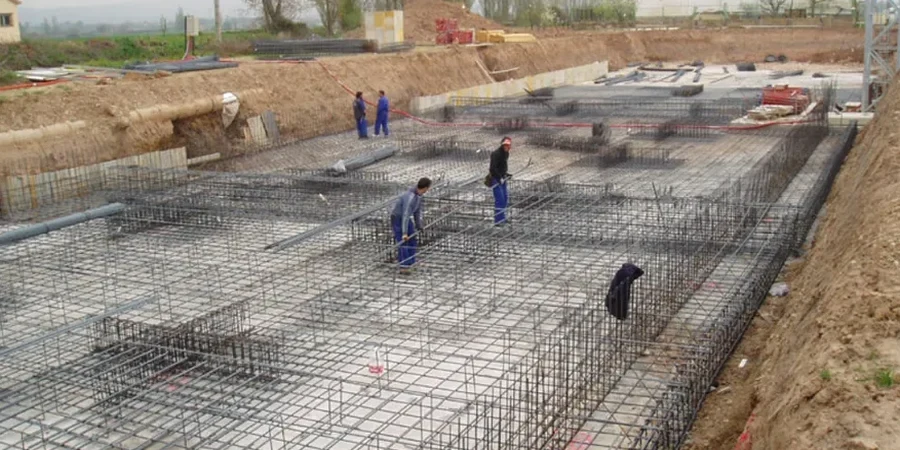
With a history stretching back to the 6th century, Kilkenny’s medieval core sits on a complex geological interface where Carboniferous limestone meets thick sequences of glacial till. Borehole records from the Nore River valley routinely show 3 to 7 meters of firm to stiff boulder clay overlying weathered limestone bedrock—conditions that demand a careful approach to foundation design. Shallow foundation design in Kilkenny requires more than presumptive bearing values; it needs direct correlation between in-situ test data and the specific till fabric encountered on site. The technical team at Sondajes PT has worked across the city’s three principal terraces—from the floodplain gravels near John’s Bridge to the elevated till plateaus in Loughboy—and we understand how shear strength can vary by 40% within a 100-meter radius. For sites where the clay fraction exceeds 30%, we often integrate a triaxial shear test program to define the drained friction angle before sizing the footing geometry.
Bearing capacity in Kilkenny’s boulder clay is controlled as much by its preconsolidation history as by its undrained shear strength—ignore the yield stress and you’ve already underestimated settlement.
Local geotechnical context
The geotechnical contrast between Kilkenny’s medieval city center and the newer developments west of the Nore is stark. Inside the ring road, made ground up to 2 meters thick—a mix of archaeological debris, ash, and reworked till—overlies natural gravels, creating a high risk of differential settlement under strip footings. Out in the Hebron industrial estate, the till is thicker and more consistent, but the deeper weathering profile on the limestone can produce soft zones where the rockhead drops suddenly. The most underestimated risk in shallow foundation design in Kilkenny is seasonal groundwater fluctuation: the water table in the alluvial plain can rise from 3 meters depth in August to less than 1 meter in February, reducing effective stress and bearing capacity by up to 25% if not properly accounted for in the winter design case.
Relevant standards
I.S. EN 1997-1:2005 (Eurocode 7: Geotechnical design – General rules), I.S. EN 1997-1/NA: National Annex to Eurocode 7, I.S. EN 1992-1-1:2004 (Eurocode 2: Design of concrete structures, for footing reinforcement), I.S. EN ISO 22475-1:2006 (Geotechnical investigation and testing – Sampling), BRE Digest 240/242 (Low-rise buildings on shrinkable clay: reference for settlement analysis)
Top questions
What are the main soil types that affect shallow foundation design in Kilkenny?
The dominant material is glacial till—a dense, silty clay with gravel and cobbles—overlying Carboniferous limestone bedrock. Along the River Nore corridor, alluvial gravels and soft silty clays appear within 3 meters of the surface. The till itself is highly variable: some zones are matrix-dominated with low permeability, while others contain significant sand lenses that can drain freely. This variability means that presumptive bearing values from Table A.1 of the old BS 8004 are unreliable here; site-specific investigation is essential.
Which Eurocode governs shallow foundation design in Ireland?
I.S. EN 1997-1:2005 (Eurocode 7, Part 1) together with the Irish National Annex I.S. EN 1997-1/NA. Design Approach 1 is applied, requiring both Combination 1 (partial factors on actions) and Combination 2 (partial factors on material properties) to be checked. For the structural design of the reinforced concrete footing, I.S. EN 1992-1-1 applies.
How much does a shallow foundation design package cost for a residential project in Kilkenny?
For a typical single-family dwelling on a site with available ground investigation data, the design fee ranges from approximately €1,890 to €2,900. The final figure depends on the number of load cases, the complexity of the ground profile, and whether raft analysis is required instead of simpler strip footings. This includes the bearing capacity and settlement calculations, reinforcement detailing sketches, and a design report signed by a Chartered Engineer.
What is the minimum footing depth required in Kilkenny?
The National Annex to I.S. EN 1997-1 specifies a minimum embedment of 0.75 meters for frost protection and to avoid the effects of seasonal moisture changes in the upper soil layers. In practice, we often go deeper—1.0 to 1.2 meters—to seat the footing in the stiffer till below the desiccated crust, which can show significant strength reduction in summer months due to shrinkage cracking.
Do I need a raft foundation if my site is near the River Nore?
Not necessarily. Many riverside plots in Kilkenny can support conventional strip footings if the alluvial layer is thin and the underlying till is within reach. However, where the soft alluvium exceeds 1.5 meters in thickness or where the groundwater table is within 1 meter of the proposed footing base, a raft foundation becomes a more predictable option. The decision should be based on a settlement analysis that accounts for the compressibility of each layer, not on a rule of thumb.