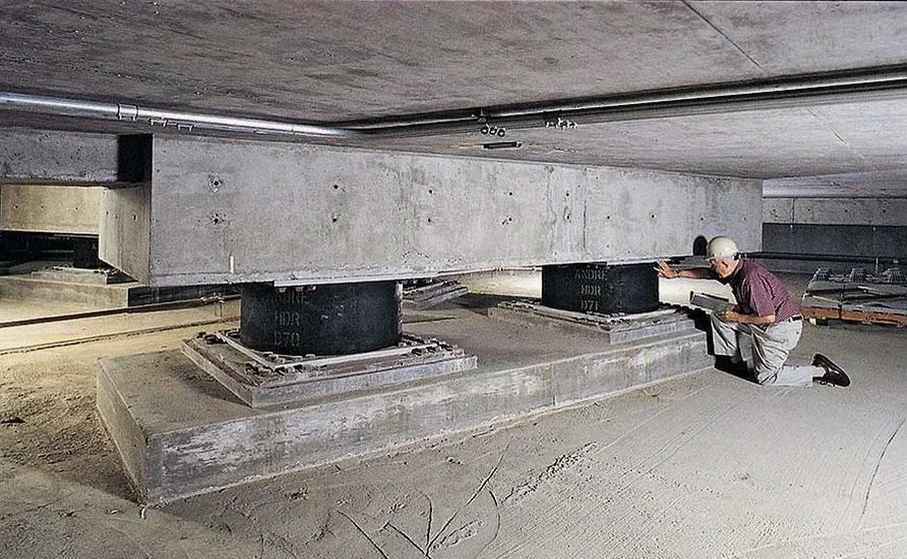
Eurocode 8 (EN 1998-1:2004) sets the framework for seismic design in Ireland, and while Kilkenny sits in a low-to-moderate seismicity zone, the historic fabric and variable ground conditions demand a careful approach. The limestone bedrock underlying much of the city provides a competent base, but the alluvial deposits along the River Nore introduce amplification risks that standard fixed-base designs cannot fully address. We apply base isolation to decouple the superstructure from ground motion, reducing inter-storey drift and protecting both structural and non-structural elements. In a city like Kilkenny, where medieval buildings stand beside modern commercial developments, isolation offers a way to meet performance objectives without compromising architectural intent. Our work integrates site-specific hazard assessment with practical installation detailing. For projects on softer riverine soils, we often pair the isolation design with a seismic refraction survey to map bedrock depth and shear wave velocity before finalising bearing strategy.
Decoupling the structure from ground motion reduces acceleration demand by 50–70%, making base isolation the most effective passive control strategy for critical facilities.
Local geotechnical context
The contrast between a site on competent limestone near St. Canice's Cathedral and one on the alluvial gravels east of the Nore illustrates the risk variability across Kilkenny. The limestone site may see low spectral acceleration but high frequency content, which can damage stiff, short-period structures. The gravel site amplifies longer-period motion, potentially coinciding with the fundamental period of a mid-rise building. Skipping site-specific hazard deaggregation risks underestimating the displacement demand on isolators, leading to moat wall impact or bearing instability. Another overlooked risk is the vertical component of ground motion, which can reduce the axial capacity of isolators and induce rocking. Our design process includes vertical seismic checks and stability verification at maximum displacement, ensuring the isolation system remains functional through and after the design event.
Top questions
Is base isolation necessary in a low-seismicity area like Kilkenny?
It depends on the structure's importance class and performance goals. For essential facilities, heritage structures, or buildings with sensitive contents, base isolation reduces damage probability significantly even at low PGA. The cost-benefit analysis often favours isolation when downtime and content loss are considered.
What does base isolation design cost for a typical project in Kilkenny?
Design fees for a base isolation system typically range from €4,250 to €6,890 depending on structural complexity, number of isolators, and analysis requirements. This covers modelling, bearing specification, peer review coordination, and construction support.
How do Kilkenny's soil conditions affect isolator performance?
The limestone bedrock offers excellent bearing, but alluvial pockets along the Nore can amplify long-period motion. We run site-specific response analyses to capture this, adjusting isolator stiffness and damping to account for soil-structure interaction effects.
Which Eurocode governs base isolation design in Ireland?
EN 1998-1:2004 covers seismic design including base isolation, with the Irish National Annex providing country-specific parameters. EN 15129 specifies anti-seismic device requirements including prototype testing and factory production control.