Kilkenny's medieval core, built upon the limestone shelves that frame the River Nore, conceals a geotechnical puzzle beneath its streets. The city's expansion beyond the ancient walls, particularly toward the Breagagh Valley and the newer residential quarters on the western fringes, has encountered glacial tills and alluvial silts that demand careful classification. With a population approaching 27,000 and a construction sector adapting to modern building regulations, the need for precise soil identification has never been more pressing. Fine-grained materials are notoriously variable in their behaviour depending on water content, and misjudging their plasticity can lead to settlement, heave, or inadequate bearing. The Atterberg limits test provides that fundamental classification by quantifying the boundaries between solid, plastic, and liquid states. For any foundation design in the city's more compressible zones, understanding these transition points is not just a laboratory exercise—it is the basis for a safe design. When the preliminary boreholes or test pits reveal a clay layer, the team moves immediately to define its consistency limits.
Atterberg limits transform an ambiguous handful of clay into a defined engineering material with predictable behaviour across its moisture range.
Scope of work
At approximately 60 metres above sea level, Kilkenny sits on a mix of Carboniferous limestone bedrock and overlying glacial deposits. The till here often contains a high proportion of silt and clay, with natural moisture contents that fluctuate seasonally. The liquid limit, typically ranging from 25% to over 60% in local lacustrine clays, defines the moisture content at which the soil transitions from plastic to liquid behaviour. The plastic limit marks the lower boundary of plasticity, and the difference between the two—the plasticity index—is a direct indicator of the soil's capacity to deform without cracking. A plasticity index above 20% signals a highly active clay, common in pockets across the Nore floodplain. The shrinkage limit, though less frequently specified, completes the picture by indicating the moisture content below which volume change ceases. These values feed directly into the Unified Soil Classification System, determining whether a material is a lean clay (CL), fat clay (CH), or silt (ML/MH). The work is performed at a controlled 105°C drying temperature, with the Casagrande cup method for the liquid limit and the thread-rolling technique for the plastic limit, as per the current Irish Standard.
Local geotechnical context
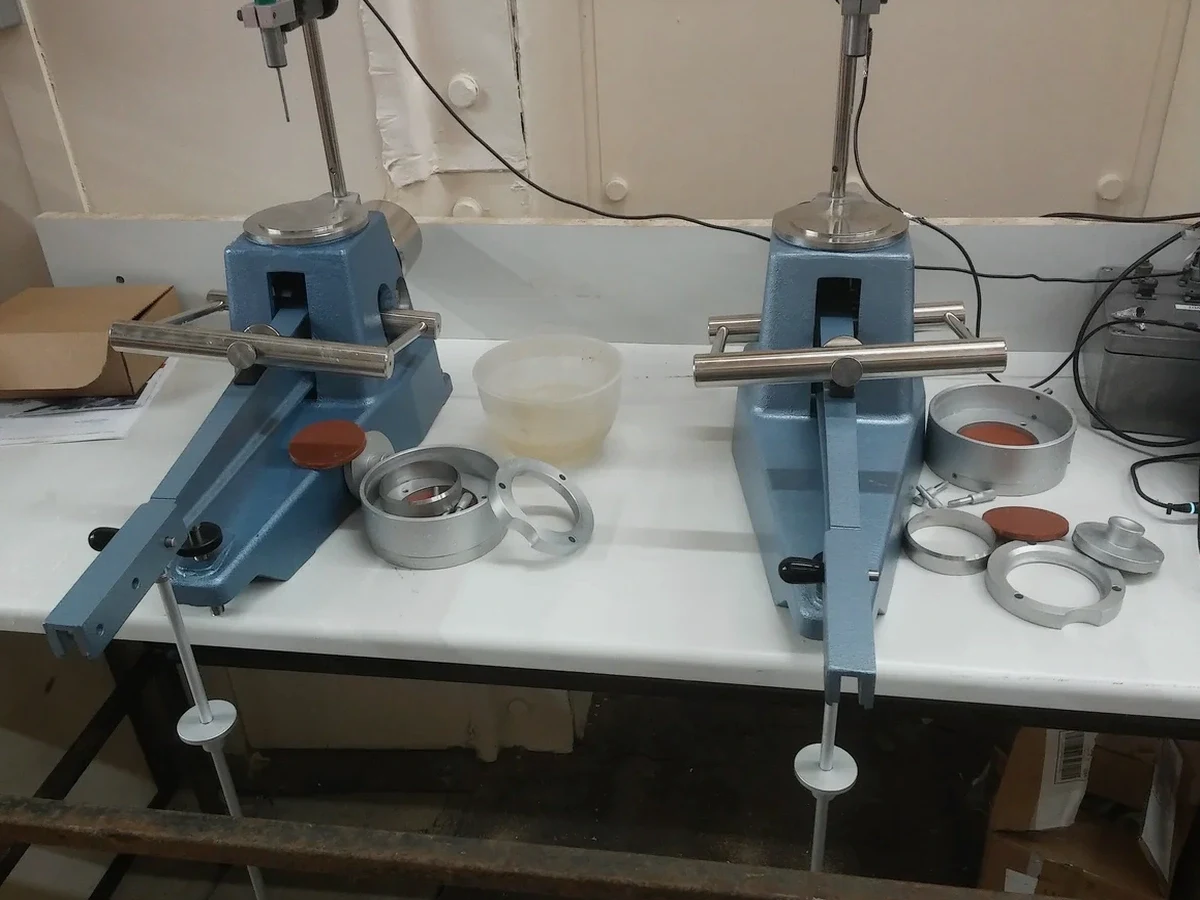
The brass cup of the Casagrande device clicks rhythmically at two rotations per second, its hard rubber base absorbing the bench vibration in a quiet corner of the lab. The technician spreads the soil paste with a spatula, cuts a clean groove with the standard tool, and counts the blows until the two halves close over a distance of 13 mm. This seemingly simple procedure carries significant consequences when ignored. A contractor who assumes a low-plasticity silt where a high-plasticity clay exists may proceed with a foundation design that underestimates swell pressure. In Kilkenny, where old river terraces contain layers of both materials in close succession, this misclassification can lead to differential movement within a single building footprint. Cracks appear in blockwork, service pipes shear, and the cost of remedial underpinning far exceeds that of a basic classification test. The Atterberg limits are not merely index values; they are the first line of defence against geotechnical misdiagnosis.
Top questions
What is the standard cost for Atterberg limits testing in Kilkenny?
The typical range is €50 to €110 per sample, covering the liquid limit, plastic limit, and the calculation of the plasticity index. The exact price depends on the number of samples in the batch and whether additional determinations like the shrinkage limit or natural moisture content are required.
How does the Casagrande cup method define the liquid limit?
The liquid limit is the moisture content at which a standard groove cut in the soil paste closes over a distance of 13 mm under 25 blows of the cup, dropped from a height of 10 mm at a rate of two drops per second. The test is repeated at three to four moisture contents, and the flow curve is plotted to interpolate the value at exactly 25 blows.
What sample quantity is needed for the test?
A representative disturbed sample of about 200 grams of material passing the 425 µm sieve is sufficient. The material must not be oven-dried before testing to avoid altering the clay mineralogy; air-drying is the preferred method of preparation.
Why is the plasticity index important for foundation design?
The plasticity index indicates the range of moisture contents over which the soil remains plastic. A high PI, above 20% to 30%, is associated with expansive clays that undergo significant volume change with seasonal moisture variation. This directly influences the depth of foundations, the need for ground improvement, and the specification of drainage measures in Kilkenny's more clay-rich glacial deposits.